Ánimas Bajas: el lujo se siembra

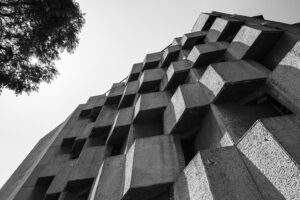
El brutalismo es de esos movimientos que se sienten antes que se entienden. Su presencia es contundente, áspera, honesta. Nació en la posguerra, entre los escombros de una Europa que necesitaba reconstruirse con urgencia y sin adornos, y desde ahí se proyectó como una declaración estética, ética y política. No vino a complacer, sino a decir la verdad.
El término proviene del francés béton brut —concreto crudo—, expresión que Le Corbusier usaba para describir el acabado sin tratar de sus estructuras de hormigón. Pero sería el matrimonio inglés de los Smithson, Alison y Peter, quienes en los años 50 y 60 darían forma a una arquitectura que rechazaba lo superficial y celebraba la función, la estructura expuesta y los materiales en su forma más pura. En paralelo, edificios como el Barbican Centre en Londres o el Unité d’Habitation en Marsella hacían del concreto un lenguaje. No sólo una solución técnica, sino una poética.
Considerado frío o inhumano, el brutalismo es, paradójicamente, profundamente humano. Porque revela el proceso constructivo, muestra las huellas de los moldes, los poros del concreto, los nervios del acero. No esconde nada. Es arquitectura con cicatrices. Esencial, franca, sin maquillaje.
En el diseño y el arte, el brutalismo ha tenido ecos igual de intensos. En mobiliario, diseñadores como Paul Evans o Donald Judd tomaron los principios de geometría severa y materiales industriales para crear piezas escultóricas y funcionales. Hoy, esa sensibilidad resuena en la estética de lo monolítico: sillas, mesas y luminarias que parecen talladas en un solo gesto, sin concesiones.
Varios artistas plásticos también han canalizado esta actitud brutalista, no necesariamente desde el concreto, sino desde la honestidad material. Eduardo Chillida, por ejemplo, trabajó el hierro como si fuera arcilla, creando formas pesadas, sólidas, pero profundamente meditativas. Richard Serra llevó el acero a dimensiones monumentales, haciendo del peso y la tensión física una experiencia estética. Incluso Louise Nevelson, con sus ensamblajes de madera pintada de negro, evocó esa misma intensidad matérica y tectónica que atraviesa el brutalismo.
El brutalismo tuvo su auge entre los años 50 y 70, pero su popularidad cayó en desgracia a finales del siglo XX. Muchos lo consideraron feo, autoritario, incluso opresivo. Y, sin embargo, en los últimos años ha regresado con fuerza, impulsado por nuevas generaciones que valoran lo auténtico, lo táctil, lo que resiste al tiempo y a la moda. En un mundo saturado de imágenes pulidas y superficies brillantes, lo brutalista ofrece un refugio de solidez.
Hoy, vemos su influencia en interiores que combinan concreto envejecido con madera natural, en jardines con esculturas pesadas y líneas simples, y en objetos de diseño que parecen resistir cualquier intento de domesticación. Es una estética que no busca gustar: busca perdurar.
Más que una moda o un estilo, el brutalismo es una postura. Frente a lo desechable, lo inmediato y lo decorativo, propone permanencia, honestidad y una especie de belleza feroz. Tal vez por eso, en estos tiempos inciertos, nos sigue hablando al oído con esa voz grave y directa que no necesita alzar el tono para ser escuchada con la seguridad de que será atemporal.
Brutalism is one of those movements you feel before you understand.
Its presence is forceful, raw, honest. It was born in the aftermath of war, among the rubble of a Europe that needed to rebuild urgently and without embellishment, and from there it projected itself as an aesthetic, ethical, and political statement. It didn’t come to please—it came to tell the truth.
The term comes from the French béton brut—raw concrete—an expression Le Corbusier used to describe the untreated finish of his concrete structures. But it was the English couple Alison and Peter Smithson who, in the 1950s and 60s, would give shape to an architecture that rejected superficiality and celebrated function, exposed structure, and materials in their purest form. At the same time, buildings like the Barbican Centre in London or the Unité d’Habitation in Marseille turned concrete into a language—not just a technical solution, but a kind of poetry.
Often seen as cold or inhuman, brutalism is, paradoxically, deeply human. Because it reveals the construction process, shows the marks of the molds, the pores of the concrete, the nerves of the steel. It hides nothing. It’s architecture with scars—essential, unfiltered, unmasked.
In design and art, brutalism has echoed with the same intensity. In furniture, designers like Paul Evans and Donald Judd embraced severe geometry and industrial materials to create sculptural yet functional pieces. Today, that sensibility lives on in a monolithic aesthetic: chairs, tables, and lamps that feel carved from a single gesture—uncompromising.
Many visual artists have also channeled this brutalist attitude—not necessarily through concrete, but through material honesty. Eduardo Chillida, for example, worked iron as if it were clay, creating heavy, solid forms that are deeply meditative. Richard Serra took steel to monumental dimensions, turning physical weight and tension into aesthetic experience. Even Louise Nevelson, with her black-painted wood assemblages, evoked that same material and tectonic intensity that pulses through brutalism.
Brutalism reached its peak between the 1950s and 70s, but fell out of favor by the end of the 20th century. Many found it ugly, authoritarian—even oppressive. And yet, in recent years, it has come roaring back, embraced by new generations who value what’s real, tactile, and built to endure. In a world oversaturated with polished images and shiny surfaces, brutalism offers a refuge of solidity.
Today, we see its influence in interiors that blend aged concrete with natural wood, in gardens with heavy sculptures and clean lines, and in design objects that resist all attempts at domestication. It’s an aesthetic that doesn’t aim to be liked—it aims to last.
More than a trend or a style, brutalism is a stance. In the face of the disposable, the instant, and the decorative, it proposes permanence, honesty, and a kind of fierce beauty. Perhaps that’s why, in these uncertain times, it still speaks to us in that deep, unflinching voice that doesn’t need to shout to be heard—because it knows it will outlast the noise.