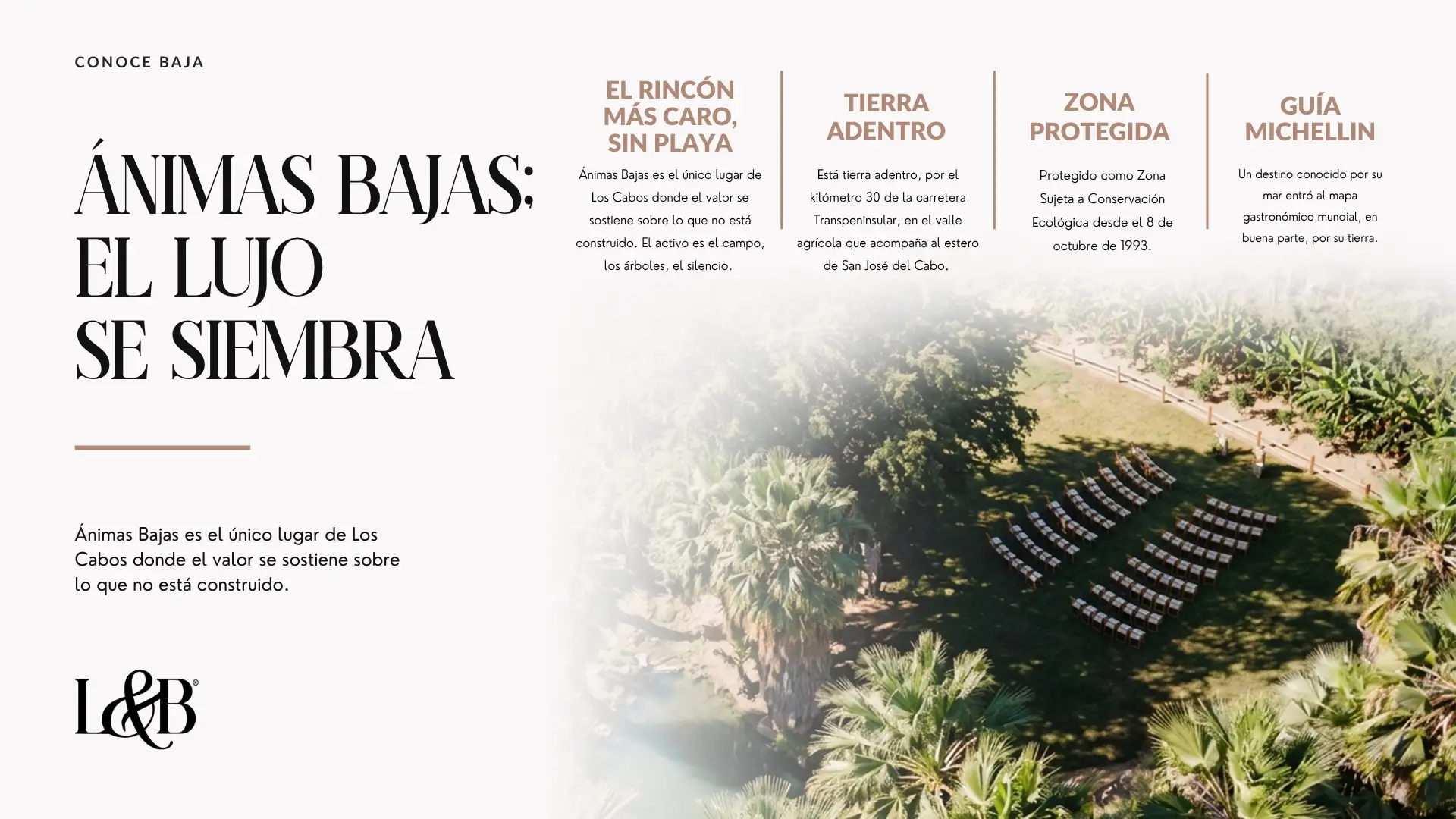
Ánimas Bajas: el lujo se siembra

Vivir frente al mar es un sueño recurrente, pero diseñar arquitectura frente al mar en el Pacífico de Baja California Sur requiere algo más que estética: exige conciencia. En esta franja entre Cerritos, Pescadero y Migriño, el diseño arquitectónico ha evolucionado hacia una propuesta donde la sustentabilidad rural no es un añadido, sino el punto de partida.
Aquí, las casas no buscan imponer. Se entierran ligeramente en el terreno, aprovechan las sombras naturales, orientan sus ventanas al viento dominante y utilizan materiales que nacen del entorno: tierra compactada, bloque artesanal, madera local, piedra de arroyo. La arquitectura costera del Pacífico está dejando de copiar modelos ajenos y está abrazando su identidad territorial. No se trata de un capricho estético: es una necesidad ecológica, económica y cultural.
Cada vez más estudios de arquitectura entienden que el lujo no está en los acabados ostentosos, sino en la conexión íntima con el paisaje. Que el verdadero valor de una casa no se mide en metros cuadrados construidos, sino en su huella ecológica, en cómo se integra al ciclo solar, en cuánta agua puede captar, en cuánta energía puede generar. Las comunidades que están naciendo aquí, pequeñas y de bajo impacto, privilegian la privacidad, la contemplación y la sencillez como un acto consciente.
El diseño costero del Pacífico se ha convertido en un lenguaje en evolución. Un lenguaje que habla de respeto por el clima, por la flora endémica, por las vistas que deben mantenerse despejadas. Es un diseño donde el arquitecto no solo dibuja: escucha. Escucha a la tierra, al viento, al mar. Y en ese diálogo silencioso, construye espacios que no solo protegen del sol, sino que celebran la vida en este rincón tan poderoso del mundo.
Desde ranchos autosuficientes hasta cabañas artísticas y hoteles boutique con visión holística, la arquitectura sustentable y rural del Pacífico no es una moda: es una necesidad urgente, una respuesta serena al vértigo del crecimiento urbano y a la crisis climática. Aquí se construye con paciencia, con respeto, con un profundo amor por lo esencial.
Y es precisamente eso lo que hoy enamora a los nuevos inversionistas: un diseño que no vende espectáculo, sino sentido. Un diseño que es tan bello como honesto. Que es moderno, sin dejar de ser profundamente local.
Living by the sea is a common dream, but designing architecture along the Pacific coast of Baja California Sur requires more than aesthetics—it demands awareness. In this stretch that includes Cerritos, Pescadero, and Migriño, architectural design has evolved into an approach where rural sustainability is not an afterthought, but the foundation.
Here, homes are not meant to dominate. They nestle into the terrain, use natural shade, face prevailing winds, and are built with materials born from the environment: rammed earth, handmade block, local wood, river stone. Coastal architecture in this region is shedding imported models to embrace its own territorial identity. It’s not about aesthetic whims—it’s about ecological, economic, and cultural necessity.
More and more architectural studios understand that true luxury is not in extravagant finishes but in an intimate relationship with the landscape. That the real value of a home lies not in square footage, but in its ecological footprint, in how it follows the sun, how much water it can capture, how much energy it can produce. The new communities emerging here—small, low-impact, intentional—favor privacy, contemplation, and simplicity as a conscious choice.
Coastal design in the Pacific has become a living language. A language that respects the climate, the native flora, the views that must remain open. It’s a design in which the architect doesn’t just draw—listens. Listens to the land, the wind, the sea. And in that silent conversation, they create spaces that do more than protect from the sun—they celebrate life in one of the world’s most powerful corners.
From self-sufficient ranches to artistic cabins and boutique hotels with a holistic vision, the sustainable and rural architecture of the Pacific is not a trend—it’s an urgent need, a calm response to the vertigo of urban growth and the climate crisis. Here, we build with patience, respect, and a deep love for the essential.
And that is precisely what attracts today’s investors: design that doesn’t sell spectacle, but meaning. A design that is as beautiful as it is honest. That is modern while being deeply local.