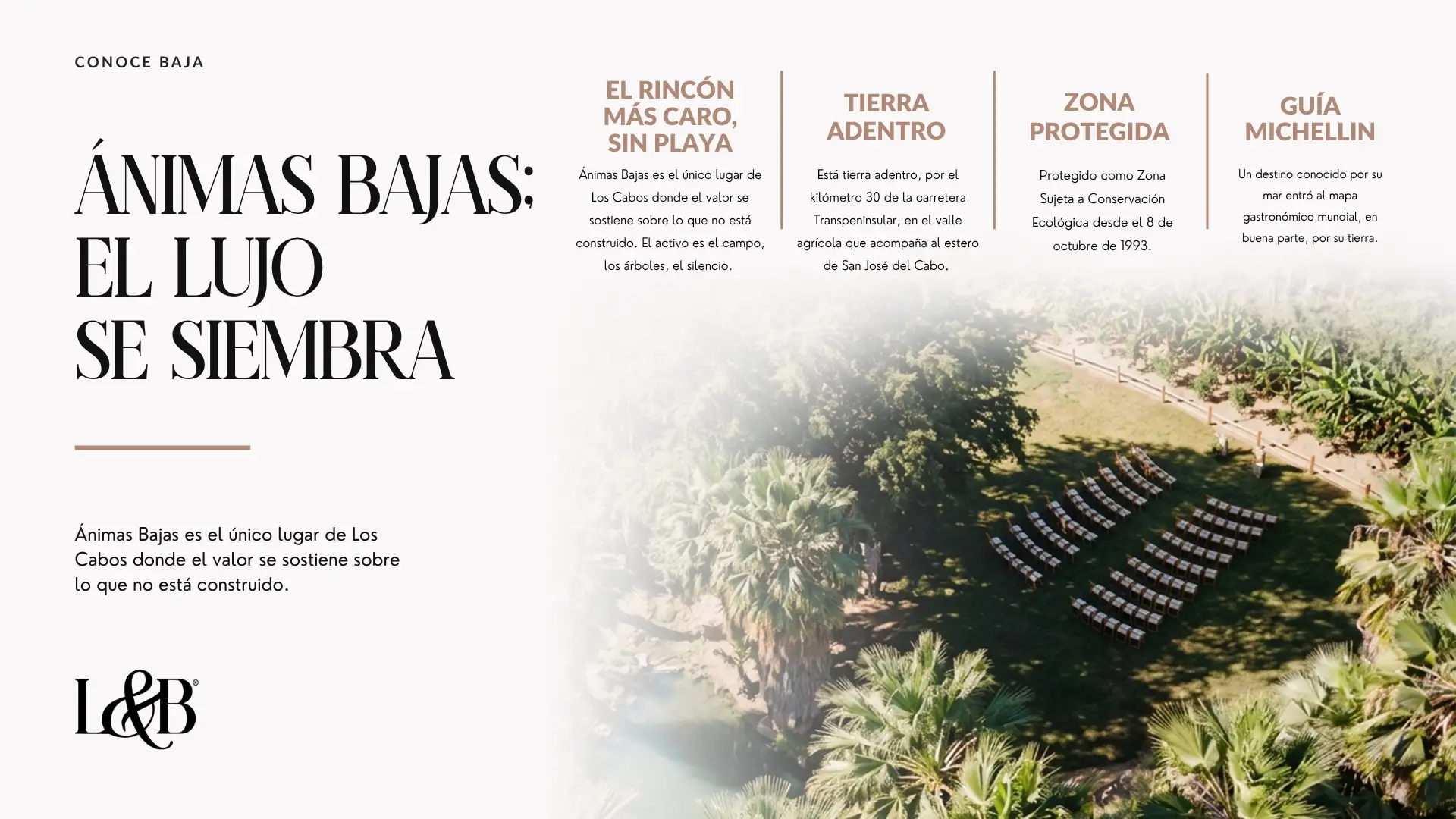
Ánimas Bajas: el lujo se siembra


El crecimiento territorial de Baja California Sur ha dejado de ser una proyección a futuro: es una realidad que avanza con velocidad y exige respuestas técnicas, urbanas y éticas de una magnitud inédita. En este escenario, ingenieros y arquitectos se encuentran en el centro de un desafío decisivo: cómo acompañar la expansión sin comprometer la identidad, la sostenibilidad y la capacidad real del territorio.
La región experimenta presiones simultáneas: aumento demográfico, demanda de vivienda, infraestructura insuficiente, escasez de agua, movilidad fragmentada y un modelo económico basado en turismo de alto nivel. Cada uno de estos factores implica decisiones de diseño y planeación que, si no se articulan con visión de largo plazo, pueden profundizar desigualdades y tensiones urbanas.
La labor del arquitecto ya no se limita a proyectar espacios bellos o funcionales; debe interpretar la cultura del sitio, leer el paisaje y anticipar el impacto social del desarrollo. Por su parte, el ingeniero enfrenta el reto de crear infraestructura resiliente en un territorio frágil, donde el desierto, el mar y el clima imponen límites que no pueden ignorarse. El crecimiento no es solo una oportunidad: es una responsabilidad técnica.
En Los Cabos, esta responsabilidad se vuelve aún más compleja. El destino crece impulsado por inversión nacional y extranjera, pero la infraestructura avanza a un ritmo desigual. El reto no es construir más, sino construir mejor: densificación inteligente, mejores sistemas de movilidad, tecnologías hídricas eficientes, energías limpias, viviendas bien ubicadas y proyectos que integren el entorno natural en lugar de desplazarlo.
La colaboración interdisciplinaria se vuelve crucial. Ingenieros, arquitectos, urbanistas, ambientalistas, desarrolladores y autoridades necesitan trabajar bajo una misma premisa: las decisiones técnicas deben alinearse con la capacidad real del territorio y con la calidad de vida de quienes lo habitan. No hay crecimiento sostenible sin análisis de datos, sin modelos predictivos, sin infraestructura planificada y sin un entendimiento profundo del contexto socioambiental.
El futuro de Baja California Sur dependerá de la habilidad de estos profesionales para traducir conocimiento técnico en soluciones territoriales robustas. La región necesita líderes que no solo respondan a la demanda inmediata, sino que sean capaces de imaginar un territorio equilibrado, competitivo y resiliente.
Porque, al final, el crecimiento territorial no se mide en metros construidos, sino en la coherencia entre lo que edificamos y el futuro que queremos habitar.
Engineers and architects facing the challenge of territorial growth
The territorial growth of Baja California Sur is no longer a future projection: it is a rapidly advancing reality that demands technical, urban, and ethical responses of unprecedented magnitude. In this scenario, engineers and architects find themselves at the center of a decisive challenge: how to accompany expansion without compromising the identity, sustainability, and real capacity of the territory.
The region is experiencing simultaneous pressures: population growth, demand for housing, insufficient infrastructure, water shortages, fragmented mobility, and an economic model based on high-end tourism. Each of these factors involves design and planning decisions that, if not articulated with a long-term vision, can deepen urban inequalities and tensions.
The architect’s work is no longer limited to designing beautiful or functional spaces; they must interpret the culture of the site, read the landscape, and anticipate the social impact of development. For their part, engineers face the challenge of creating resilient infrastructure in a fragile territory, where the desert, the sea, and the climate impose limits that cannot be ignored. Growth is not only an opportunity: it is a technical responsibility.
In Los Cabos, this responsibility becomes even more complex. The destination is growing, driven by domestic and foreign investment, but infrastructure is advancing at an uneven pace. The challenge is not to build more, but to build better: smart densification, better mobility systems, efficient water technologies, clean energy, well-located housing, and projects that integrate the natural environment rather than displace it.
Interdisciplinary collaboration becomes crucial. Engineers, architects, urban planners, environmentalists, developers, and authorities need to work under the same premise: technical decisions must be aligned with the actual capacity of the territory and the quality of life of those who inhabit it. There is no sustainable growth without data analysis, predictive models, planned infrastructure, and a deep understanding of the socio-environmental context.
The future of Baja California Sur will depend on the ability of these professionals to translate technical knowledge into robust territorial solutions. The region needs leaders who not only respond to immediate demand but are also capable of imagining a balanced, competitive, and resilient territory.
Because, in the end, territorial growth is not measured in square meters built, but in the coherence between what we build and the future we want to inhabit.