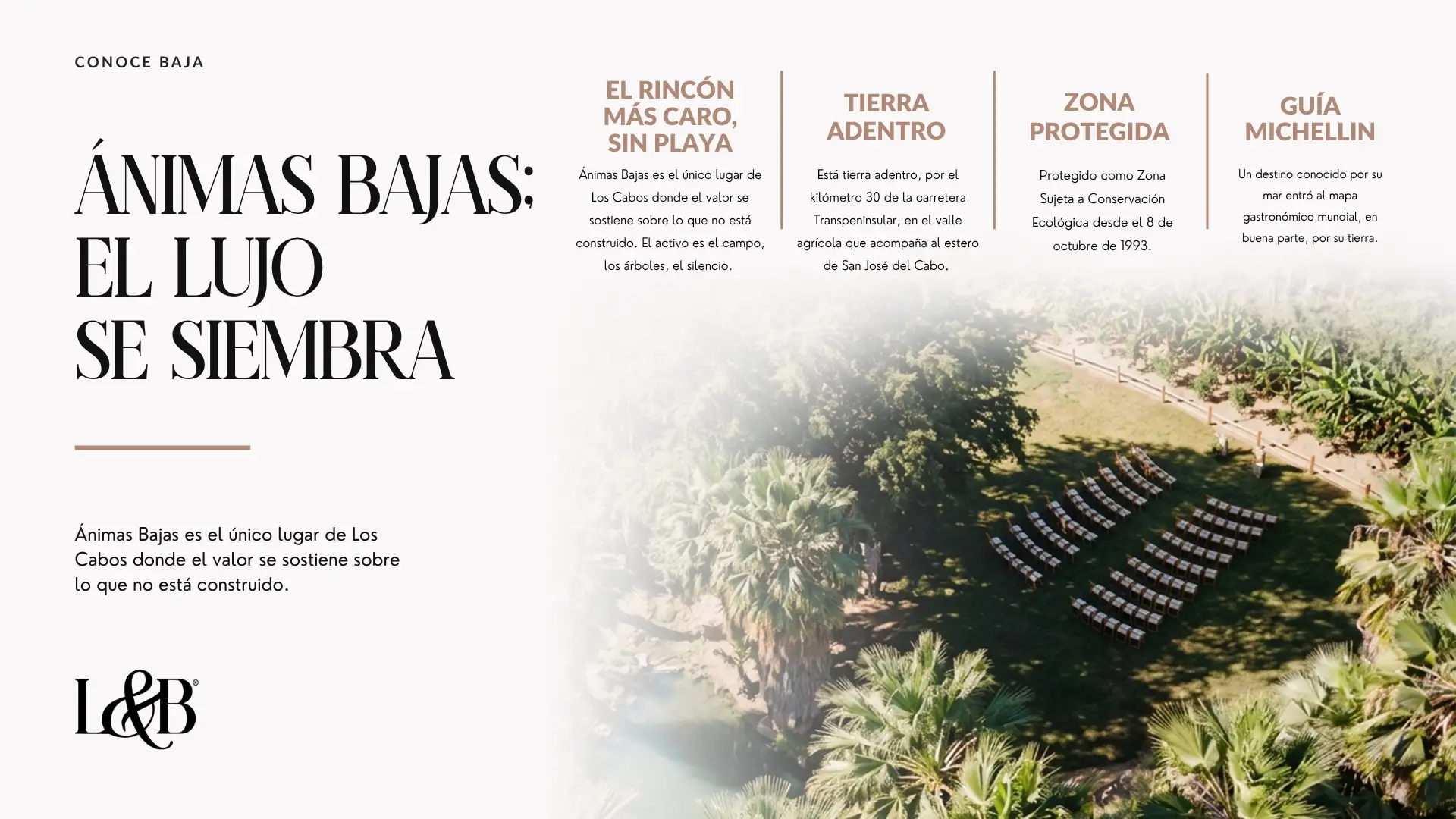
Ánimas Bajas: el lujo se siembra

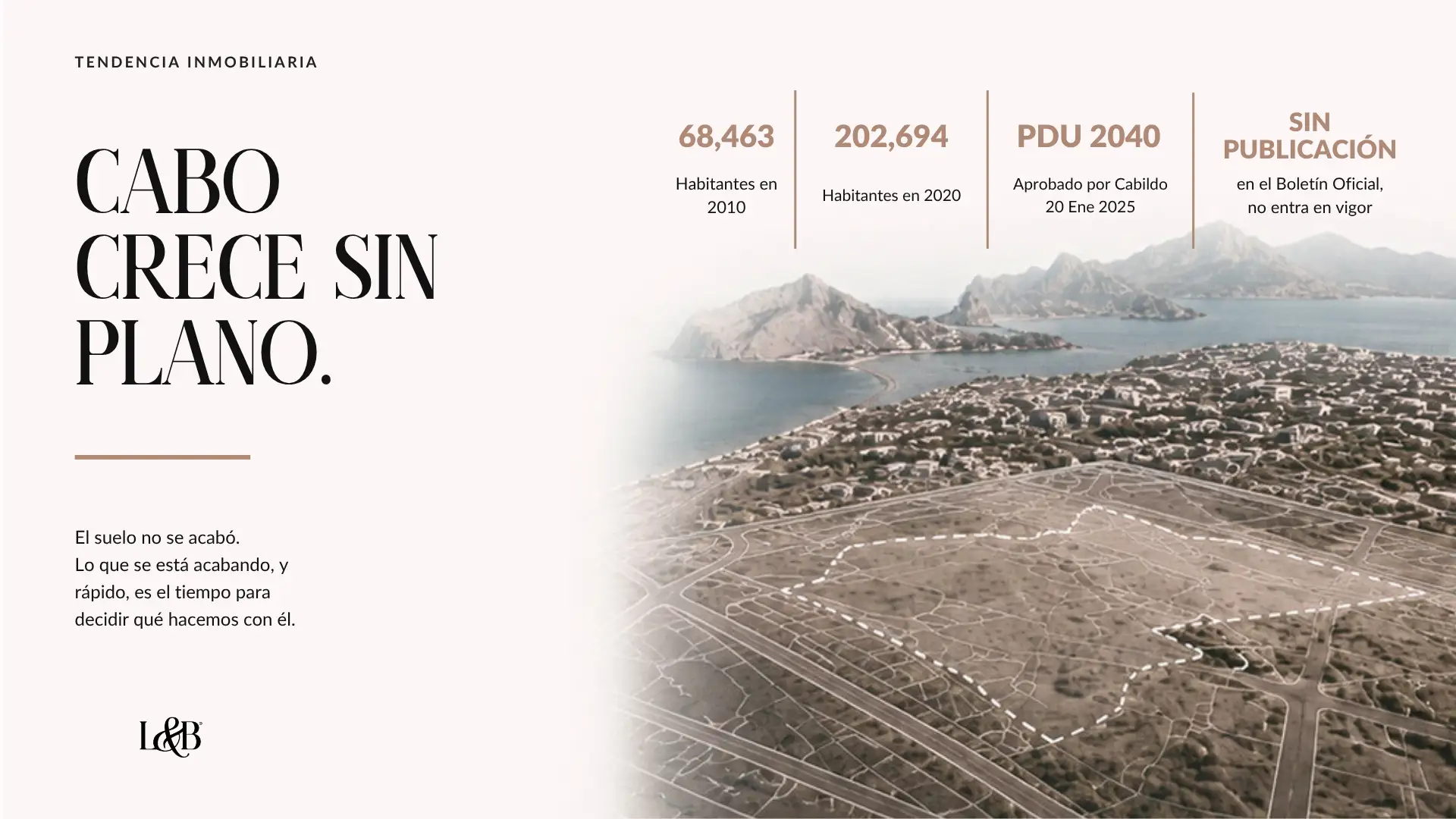
Cabo crece sin plano
Cada vez que escucho que en Cabo San Lucas ya se acabó el suelo, pienso lo mismo: suelo hay. Lo que no hay, todavía, es un plano vigente que diga qué se puede construir y dónde.
El crecimiento es público y está medido. En el censo de 2010, Cabo San Lucas tenía 68,463 habitantes. En el de 2020, 202,694. Se triplicó en diez años. Y el instrumento que debía ordenar ese crecimiento, el Plan de Desarrollo Urbano, se aprobó en 2013. Es el mismo que sigue rigiendo hoy.
No es que nadie lo haya intentado. La tercera actualización, el PDU 2040, se trabajó desde 2022, tuvo consulta pública del 23 de agosto al 14 de diciembre de 2023 con 69 participaciones formales, y el Cabildo la aprobó el 20 de enero de 2025. Ahí se detuvo. El Gobierno del Estado rechazó publicarla en el Boletín Oficial por el tratamiento que el documento daba al camino costero de Cabo del Este. Y sin esa publicación, el plan no entra en vigor.
Yo pienso que aquí está lo que casi nunca se dice en voz alta: la discusión se volvió política, pero el costo es técnico y económico. Cuando no hay plano vigente, cada proyecto termina negociando su propia densidad, su propio uso y su propia altura, caso por caso. El desarrollador no sabe con certeza qué le van a autorizar. El comprador no sabe qué le van a construir enfrente. El vecino se entera cuando ya hay grúa.
Y ese costo ya tiene cara concreta. El Programa Nacional de Vivienda avanza en Los Cabos con predios detenidos, porque requieren una clasificación de suelo que solo daría el plan actualizado. Dicho de otro modo: hay vivienda que no se está construyendo mientras un documento espera una firma.
Desde mi punto de vista, el desacuerdo sobre un camino costero es legítimo y merece resolverse bien. Lo que no me parece defendible es que, mientras se resuelve, una ciudad que se triplicó en una década siga creciendo bajo un plano dibujado hace más de diez años. Un plan de desarrollo urbano no es un trámite ni un trofeo de administración: es la regla del juego, y sin regla vigente no hay certeza para nadie, ni para quien construye ni para quien vive aquí.
El suelo no se acabó. Lo que se está acabando, y rápido, es el tiempo para decidir qué hacemos con él.
A City Growing Without a Blueprint
Every time I hear that Cabo San Lucas has run out of land, I think the same thing: there is land. What we still do not have is a valid blueprint telling us what can be built, and where.
The growth is public and measured. In the 2010 census, Cabo San Lucas had 68,463 residents. By 2020, 202,694. It tripled in ten years. And the instrument meant to guide that growth, the Urban Development Plan, was approved in 2013. It is still the one in force today.
It is not that no one tried. The third update, known as PDU 2040, was worked on from 2022, went through public consultation from August 23 to December 14 of 2023 with 69 formal submissions, and was approved by the municipal council on January 20, 2025. That is where it stopped. The state government refused to publish it in the Official Gazette over how the document treated the coastal road in Cabo del Este. And without that publication, the plan does not take effect.
I think this is the part that rarely gets said out loud: the argument turned political, but the cost is technical and economic. With no valid blueprint, every project ends up negotiating its own density, its own land use and its own height, case by case. The developer cannot be certain what will be approved. The buyer does not know what will go up across the street. The neighbor finds out when the crane arrives.
And that cost already has a face. The National Housing Program is moving forward in Los Cabos with parcels on hold, because they need a land classification only the updated plan would provide. Put plainly: there is housing not being built while a document waits for a signature.
From my point of view, disagreement over a coastal road is legitimate and deserves to be resolved properly. What I cannot defend is that, while it gets resolved, a city that tripled in a decade keeps growing under a blueprint drawn more than ten years ago. An urban development plan is not paperwork, and it is not an administration’s trophy. It is the rule of the game, and with no rule in force there is no certainty for anyone, neither for those who build nor for those who live here.
The land has not run out. What is running out, and fast, is the time to decide what we do with it.